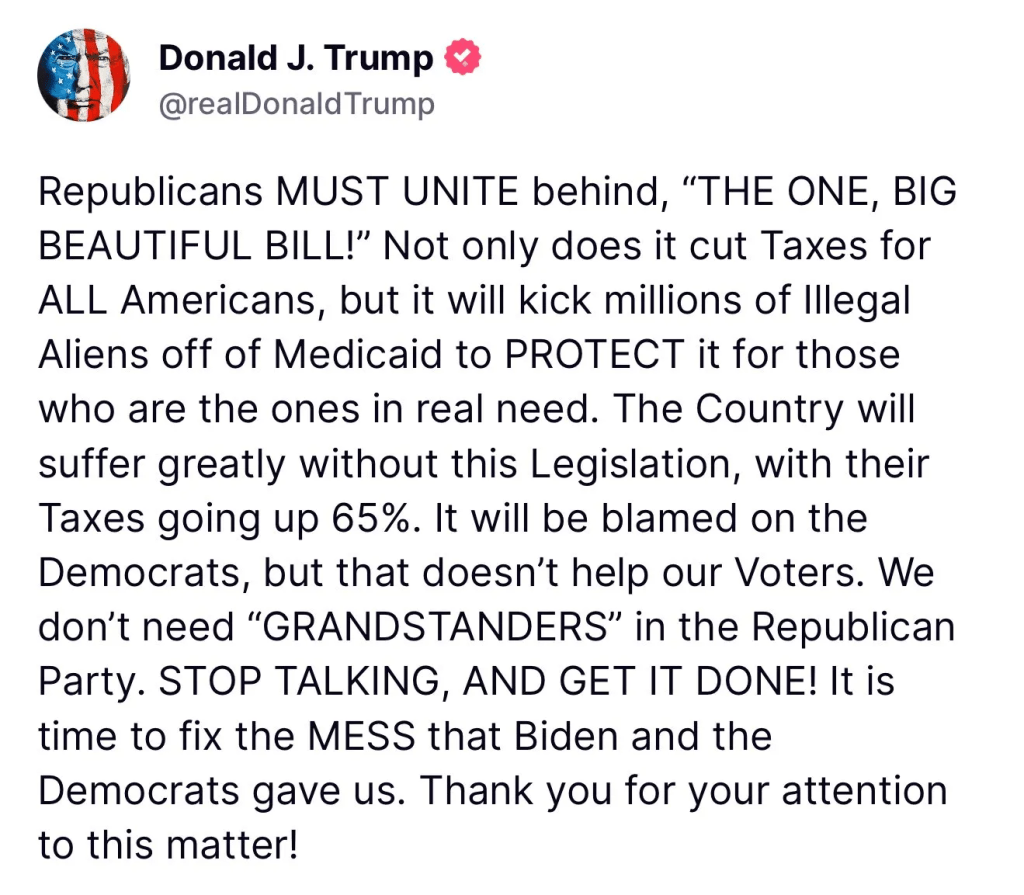
Posted May 16, 2025 at 9:07 AM by President Trump on Truth Social. The image is now displayed under an article outlining the President’s support of “The One, Big, Beautiful Bill.”
Despite the optimism implied in this title, the House Budget Committee did not block the bill from passing to the House floor based on cuts to healthcare spending or the massive tax cuts Republicans have proposed. Four Republican Representatives have voted against passing Trump’s “The One, Big, Beautiful Bill” in favor of larger cuts and shorter deadlines for disabling Biden-era clean energy programs. The committee plans to reconvene on Sunday. Even Fox News is reporting this development as a loss for Donald Trump.
The Associated Press reported back on February 12th that Republicans aimed to create more than $4.5 trillion in tax cuts, and adding $4 trillion to the debt ceiling in order to finance their proposed cuts. Republicans requested various house committees cut budgets, including orders that the Energy and Commerce Committee cut $880 billion in spending, a committee which oversees health care spending. At the time, House Democrats were already sounding alarms on the imbalance between proposed cuts and where that loss in revenue would be made up.
As the bill approached voting, the full text was released. On May 15th, the Associated Press reports the Joint Committee on Taxation estimated the total cost of the proposed tax cuts at around $4.9 trillion dollars over the next 10 years. In an effort to offset this cost, House Republicans have proposed more strict work requirements to SNAP benefits and Medicaid. In an effort to cut $290 billion in nutrition assistance, the House Agriculture Committee has posed restrictions requiring those who have the physical capacity and no dependents to work until age 64, instead of 54, to qualify for food assistance.
However, the main focus continues to be the battle over healthcare costs in this country. Again, Republicans pose work requirements of 80 hours per month for Medicare expansion recipients, which they cite as an effort to reduce “waste, fraud, and abuse” in federal assistance falling under the Affordable Care Act.
In a letter to the Senate Committee on Finance and the House Committee on Energy and Commerce on May 7th, 2025, the Congressional Budget Office highlights options for cutting Federal spending in relation to Medicaid. CBO, a nonpartial agency within the legislative branch that analyzes economic consequences and budget-related issues to assist Congress in budget development, proposes transferring many those costs to the states. Ultimately, those options offered would, in four out of five options provided, the states would likely have to reduce spending overall, through reducing payment so healthcare providers, reducing coverage overall, or reducing the number on individuals who are eligible for Medicaid. Alternatively, the states would have to reallocate budgets in other areas to cover the loss of federal support. Additionally, CBO speculated on the effects of enacting these measures, reporting that by 2034, 2.4 million people who lost Medicaid coverage would be without any form of healthcare coverage.
I am, and always will be, a proponent of universal healthcare. Any country that would pride itself to the right to life should also be a proponent of caring for its citizens. I am of the opinion that the health insurance system will always fall short in accessibility and effectiveness, compared to socialized medicine.
The Commonwealth Fund is an independent foundation in the United States that is working “to promote a high-performing, equitable health care system that achieves better access, improved quality, and greater efficiency, particularly for society’s most vulnerable, including people of color, people with low income, and those who are uninsured,” as dictated in their Mission Statement. In 2024, the foundation performed the Commonwealth Fund 2024 Biennial Health Insurance Survey to research the effectiveness of insurance coverage. Twenty-three percent of respondents reported they had coverage throughout the year, but qualified as underinsured. In those who were described as “not underinsured,” thirty-six percent still experienced barriers to receiving care due to cost, compared to seventy-percent of those who were uninsured throughout the year. I would encourage you to read more about the survey results. The Commonwealth Fund has publications for their Health Care Affordability Survey and Unforeseen Health Care Bills and Coverage Denials by Health Insurers. I completely understand if that is a lot of information, it is a lot. I pull these reports in to show that people are not satisfied with where we are now. People are underinsured, overpaying, and being denied coverage for the care they need. Finally, according to the Commonwealth Fund, Americans, we experience the worst health outcomes, and are more likely to succumb to conditions that could’ve been treated.
We as Americans have been fighting over the answer to these inadequacies for longer than I have been alive, and it is a valid discussion. However, the answer is NOT to cut out access to care for the poorest, weakest, youngest, oldest, and most sick Americans. Even now, people are choosing to skip necessary medications, forgo specialty care, and neglect regular preventative care and chronic condition maintenance appointments. This is BEFORE enacting the proposed $880 billion cut to Medicaid.
We are too advanced a nation to pretend that socialized medicine would be a disadvantage. I believe our private insurance industry has so skewed the opinions of politicians and individuals across the country that people genuinely believe that the downfall of the health insurance system would be devastating to the country. I implore you to consider protecting human beings over protecting an industry that has proven saving money is more important than the lives and wellbeing of their policy holders. Even if you have good coverage, your bills are paid, and you have the luxury of being in good health, does not mean your experience should dictate the lives of those around you. You are closer to one catastrophe pushing you to bankruptcy than you are to becoming a millionaire.
Thirty-one other first world nations have socialized medicine. It has been proven to be a model that increases life expectancy and lowers avoidable death rates. We should not be satisfied with being the laughing stock of the western world. By nature of being here, contributing to this country’s success, we should have earned our right to life and pursuit of happiness. We can be happier, more successful, and work better and harder if we can maintain our baseline health without risking losing our homes our livelihood.
I didn’t know where else to fit this into the story, but there have been proposals to improve health outcomes in the US, as any one would expect. One such proposal is, as I said, a universal healthcare system, specifically a single-payer health system, where the government is designated as the payer for all citizen under one plan. If you would like to read more about it, I found an article published with the National Library of Medicine that analyzes the impact of a single-payer system in the US, citing savings of around $450 billion per year.
Sources Cited
Elkind, E., & Olson, T. (2025, May 16). Handful of Republicans sink Trump’s “big, beautiful bill” in key House committee. Fox News. https://www.foxnews.com/politics/trumps-big-beautiful-bill-suffers-massive-defeat-key-hurdle-before-house-wide-vote
Freking, K., & Mascaro, L. (2025b, May 14). What’s in Trump’s big bill? Trillions in tax cuts, Medicaid changes and more | AP News. AP News. https://apnews.com/article/trump-tax-cuts-bill-medicaid-work-requirements-17cbde167f3b434e925a199c3253b8e1
Freking, K., & Mascaro, L. (2025, February 13). House Republicans share plan to extend tax cuts, lift debt ceiling | AP News. AP News. https://apnews.com/article/house-republicans-budget-blueprint-trump-tax-cuts-ff2bddf31f4e7cb0928139072392a091
Swagel, P. L. & U.S. Congress. (2025). Estimates for Medicaid policy options and state responses. In R. Wyden & F. Pallone Jr., Estimates for Medicaid Policy Options and State Responses. https://www.cbo.gov/system/files/2025-05/Wyden-Pallone_Letter.pdf
“The One, Big, Beautiful Bill Is a Once-in-a-Generation Chance.” The White House, The United States Government, 16 May 2025, http://www.whitehouse.gov/articles/2025/05/one-big-beautiful-bill-is-a-once-in-a-generation-chance/.
Collins, Sara R, and Avni Gupta. “The State of Health Insurance Coverage in the U.S.” State of Health Insurance Coverage in U.S.: 2024 Biennial Survey | Commonwealth Fund, The Commonwealth Fund, 21 Nov. 2024, http://www.commonwealthfund.org/publications/surveys/2024/nov/state-health-insurance-coverage-us-2024-biennial-survey.
Collins, Sara R, et al. “Paying for It: How Health Care Costs and Medical Debt Are Making Americans Sicker and Poorer.” Healthcare Affordability in America | Commonwealth Fund, The Commonwealth Fund, 26 Oct. 2023, http://www.commonwealthfund.org/publications/surveys/2023/oct/paying-for-it-costs-debt-americans-sicker-poorer-2023-affordability-survey.
Galvani, Alison P, et al. “Improving the Prognosis of Health Care in the USA.” PubMed Central, U.S. National Library of Medicine, 15 Feb. 2020, pmc.ncbi.nlm.nih.gov/articles/PMC8572548/.
Gupta, Avni, et al. “Unforeseen Health Care Bills and Coverage Denials by Health Insurers in the U.S.” Denial of Care Based on Inability to Pay | Commonwealth Fund, The Commonwealth Fund, 1 Aug. 2024, http://www.commonwealthfund.org/publications/issue-briefs/2024/aug/unforeseen-health-care-bills-coverage-denials-by-insurers.
Gunja, Munira, et al. “U.S. Health Care from a Global Perspective, 2022: Accelerating Spending, Worsening Outcomes.” Global Perspective on U.S. Health Care | Commonwealth Fund, The Commonwealth Fund, 31 Jan. 2023, http://www.commonwealthfund.org/publications/issue-briefs/2023/jan/us-health-care-global-perspective-2022.

 Empathy in Progress
How do you feel?